
Illuminating Fashion: Dress in the Art of Medieval France and the Netherlands
3 of 48
This exhibition explores the evolution of courtly clothing from the
"Fashion Revolution" around 1330 to the flowering of the Renaissance
in France following the accession of King François I in 1515. During this
period, the modern notion of changing fashion was reborn. Because
few actual garments from the Middle Ages survive, we use the art of
this era — illuminated manuscripts and early printed books — to reveal
its evolving styles. Concentrating on France and Flanders, this show
also makes the occasional foray into England, Germany, and Holland.
In addition, the exhibition touches on the potential impact of
political unrest and social upheaval on the history of fashion during
one of the world's more calamitous eras. The vicissitudes of the
Hundred Years' War, the occupation of Paris by the English, and
the arrival of the Italian Renaissance in northern Europe, for example,
influenced clothing styles.
Also explored here are the ways in which artists used clothing
(garments actually worn) and costume (fantastic garments not actually
worn) to help contemporaneous viewers interpret a work of art. The
garments depicted were often encoded clues to the wearer's identity
and moral character.
This exhibition is generously underwritten by a gift in memory of Melvin R. Seiden and
by a grant from the Samuel H. Kress Foundation.
Major support is provided by The Coby Foundation, Ltd., with additional assistance from
the van Buren family in memory of Dr. Anne H. van Buren, and from the Janine Luke and
Melvin R. Seiden Fund for Exhibitions and Publications.


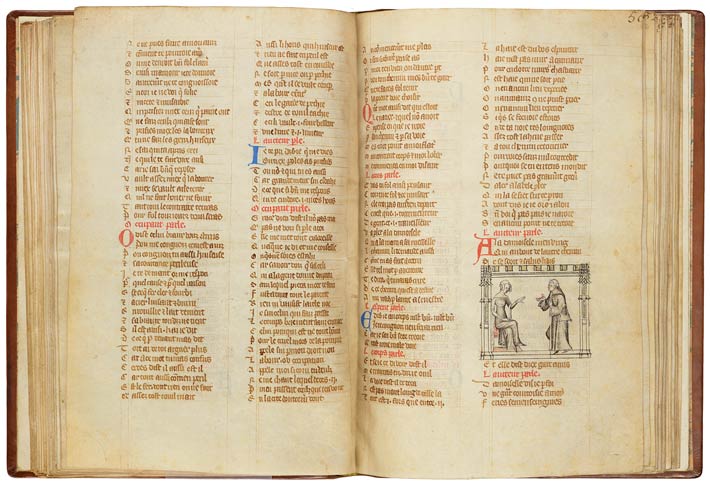
Idleness Personified
1348
In this allegorical treatise, Idleness is personified as a lazy but beautifully
dressed and perfectly coiffed young woman. The tight bodice of her surcot
cinches her high, narrow waist, emphasizing the curves of her bosom and
belly. Slender tippets fall from her elbows, and the pointed tips of her narrow
shoes poke from beneath her hem. A low neckline exposes her neck and
the tops of her shoulders, while braided hair frames her face. She gestures
condescendingly toward the humble pilgrim, dressed like a monk and
equipped with a walking stick and satchel of provisions.
Guillaume de Deguileville,
Pilgrimage of Human Life,
in French and Latin
France, 1348
220 x 150 mm
Purchased, 1931; MS M.772, fols. 49v–50r
The "Fashion Revolution" began around 1330 with the invention of the set-in sleeve. Earlier garments were T-shaped, with sleeves of a piece with the body or sewn on a flat seam. The new technique (still in use today) cut sleeves with rounded tops and gathered them along basted threads into armholes in the bodice. This new tailoring, combined with the use of multiple buttons, made possible a snugly fitted bodice and tight sleeves. While providing more freedom of movement, the new garment for men—the cote hardy—also revealed the shapes of the wearer's torso and arms. The "Fashion Revolution" gave birth to men's modern dress, creating an outfit that was sharply differentiated from the dress of women.
Women's fashions, however, were also affected. Tighter bodices and sleeves became popular, as did exposed necks and shoulders. The sides of the outer garment, the surcot, now sometimes featured seductively large, peek-a-boo openings.
Men—and some women—turned the chaperon (a hood with an attached cape and tail) into a fashion accessory that lasted over a hundred years.