

A Stately Funeral, Rechab and Baanah, Traitors
Old Testament Miniatures with Latin, Persian, and Judeo-Persian inscriptions
Purchased by J.P. Morgan (1867–1943) in 1916
Folio 38r (Latin)
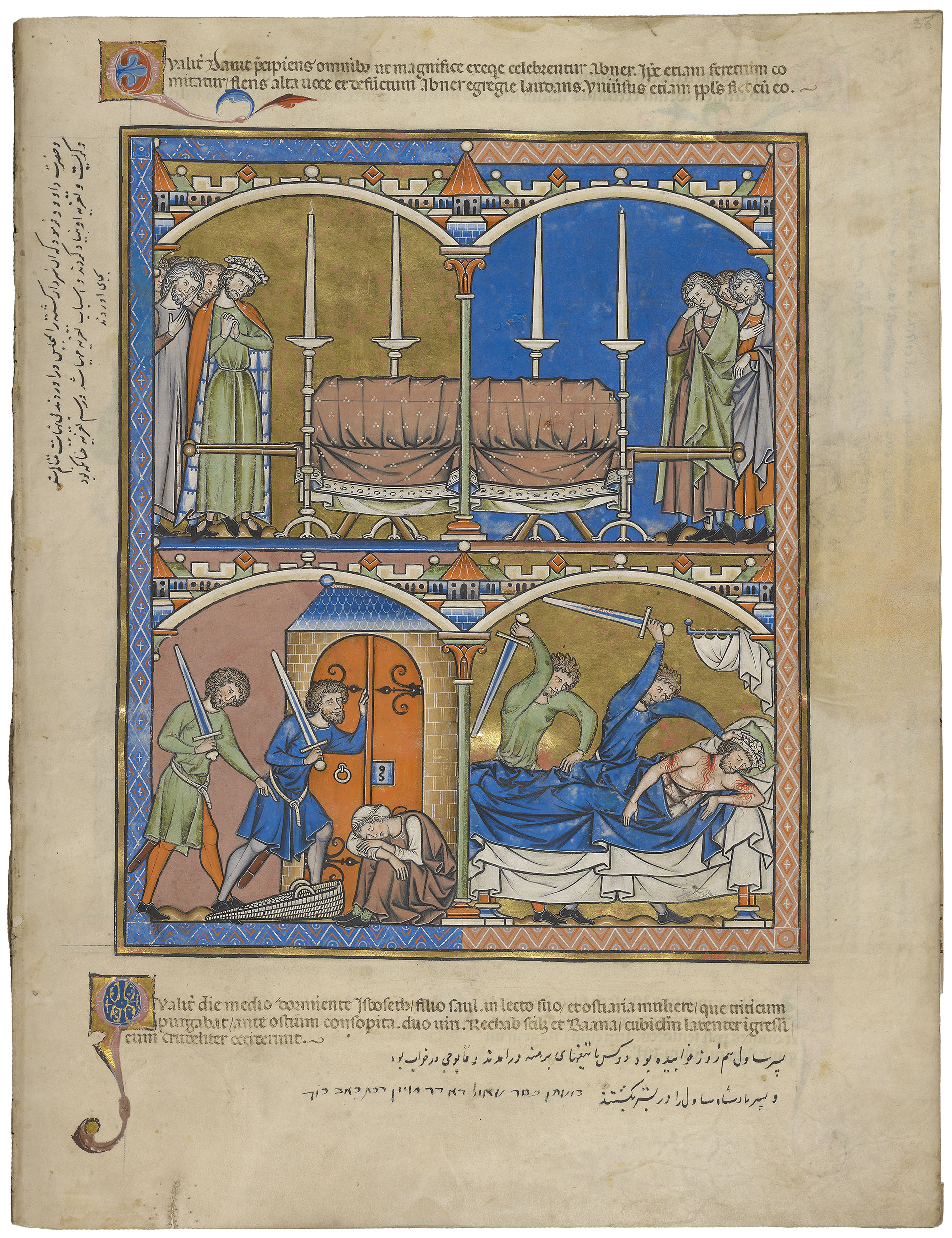
Upper half: How David, ordering all to honor Abner with a magnificent funeral, follows the bier himself, weeping loudly and praising the dead Abner admirably. All the people weep with him. (2 Samuel 3: 31–39)
Lower half: How, as Ish-bosheth, Saul’s son was sleeping in his bed in the middle of the day and the portress who was winnowing the grain had fallen asleep, two men, that is Rechab and Baanah, came secretly into his bed chamber and killed him. (2 Samuel 4:1–2, 5–7)
Folio 38r (Persian)
Upper left margin: His Excellence David ordered the slain commander to be brought to the court and he [David] was exceedingly saddened and wept; they began mourning him and the necessities for the mourning were prepared and they performed the mourning ritual as was the custom.
Lower right: That same day, the son of Saul was sleeping and two persons came in with drawn swords, and the gatekeeper was asleep, and they slew Saul’s son in bed.
Folio 38r (Judeo-Persian)
Lower half, beneath Persian: The killing of Saul’s son in his bed.
Translated by Vera Basch Moree
A Stately Funeral
David and his fellows grieve for Abner and prepare his burial in Hebron. Abner's richly draped coffin is set on a bier with projecting handles and is surrounded by four enormous tapers set on tripods. (2 Kings 3:31–34)
Rechab and Baanah, Traitors
News of Abner's death has spread throughout Israel, and Ishbosheth fears for the safety of his kingdom. Two of Ishbosheth's captains, Rechab and Baanah, decide to defect. They are certain that if they slay Ishbosheth they will gain great favor in David's eyes. Here, the long-haired rogues, swords drawn, arrive at the king's house to find the doorkeeper asleep, exhausted from sifting grain. The traitors creep to the sleeping Ishbosheth in his chamber and kill him. (2 Kings 4:1–7)