

The Final Indignity, A Doleful Task, A Funeral Pyre, Sad Tidings
Old Testament Miniatures with Latin, Persian, and Judeo-Persian inscriptions
Purchased by J.P. Morgan (1867–1943) in 1916
Folio 35v (Latin)
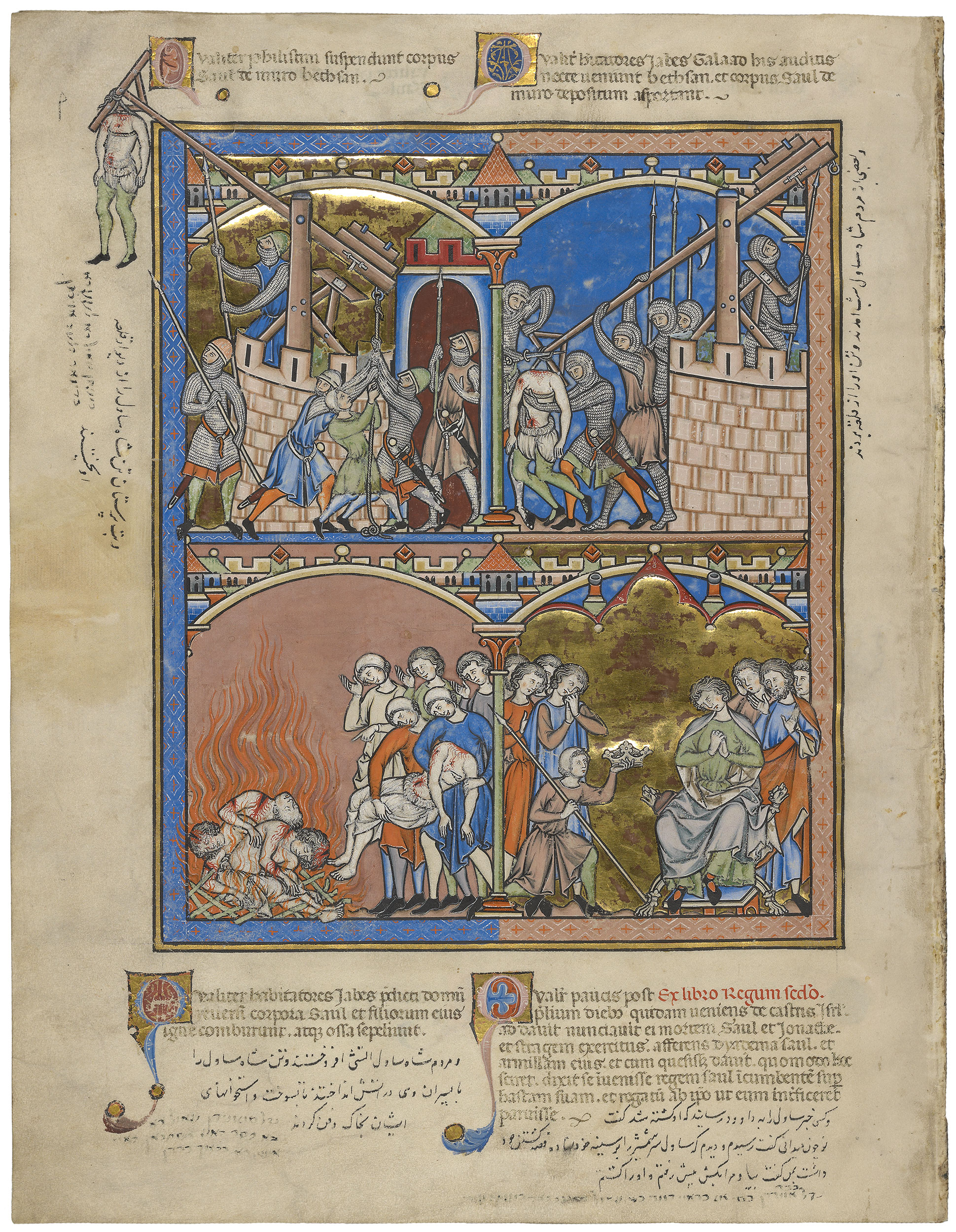
Upper left: How the Philistines hand Saul’s body from the wall of Beth–shan. (I Samuel 31: 10)
Upper right: How, when they had heard this, the inhabitants of Jabesh-gilead come at night to Beth-shan, take Saul’s body down from the wall, and carry it away. (I Samuel 31: 1, 12)
Lower left: How the above-mentioned inhabitants of Jabesh come back home, burn up the bodies of Saul and his sons in fire and bury their bones. (I Samuel 31:12)
Lower right: From the second book of Kings [2 Samuel]. How, a few days after the battle, someone from the Israeli camp came to David and told him about the death of Saul, Jonathan, and the captain of the army, carrying Saul’s diadem and his bracelet. Now, when David had asked how he knew it, he said that he had found king Saul lying on his spear, and, having been asked by the king to kill him, he had obeyed. (2 Samuel 1: 1–10)
Folio 35v (Persian)
Persian foliation: 9 (in reverse)
Upper left margin: And the idolaters hung King Saul’s body from the wall of the castle.
Upper right margin: Some of King Saul’s people came in the night and removed his body from the castle.
Lower left: The people of King Saul made a fire and threw King Saul’s body together with his sons’ [bodies] into the fire till they burned and they buried their bones.
Lower right: Someone brought the news of Saul to David that he has been slain. He said, "How do you know?" [The messenger] said, "I arrived and saw that Saul had placed the tip of a sword at his breast and intended to kill himself. [Saul] said, ’Come and kill me’. I went forth and killed him.
Folio 35v (Judeo-Persian)
Upper left margin, furthest left: [After] the killing of Saul his corpse was hung from the walls.
Lower left, below Persian: The tale of [the burning] of Saul and his sons and the burying of their bones.
Lower right, beneath Persian: Someone brings the news to David that Saul [and his sons were killed].
The Final Indignity
The Philistines have strung Saul's decapitated body to a war engine and suspended the corpse above the city walls of Beth Shan. Three men pull down on the counterpoise, raising the gruesome trophy, while a fourth guides the swinging joist with his spear. (1 Kings 31:10)
A Doleful Task
Having learned how the Philistines disgraced the king's corpse, valiant men of Jabesh Gilead journey through the night in secret to retrieve the bodies of Saul and his sons. As one soldier pushes the war engine's counterpoise upwards with his spear, his fellows, wearing mournful expressions, hold down the joist and cut loose the king's body. (1 Kings 31:11–12)
A Funeral Pyre
Grieving men of Jabesh Gilead prepare to place Saul's corpse on the same enormous fire that consumes his dead sons. They will collect the bones and bury them in the woods of Jabesh Gilead, and afterwards fast for seven days. (1 Kings 31:12–13)
Sad Tidings
A survivor of the Gilboa massacre arrives in Ziklag and reports to David of the deaths of Saul and Jonathan. The survivor recounts how he discovered Saul transfixed upon his own spear, and at the king's request killed him before the Philistines had the opportunity. Now he has brought the king's crown to David, its rightful owner. (2 Kings 1: 2–10)