

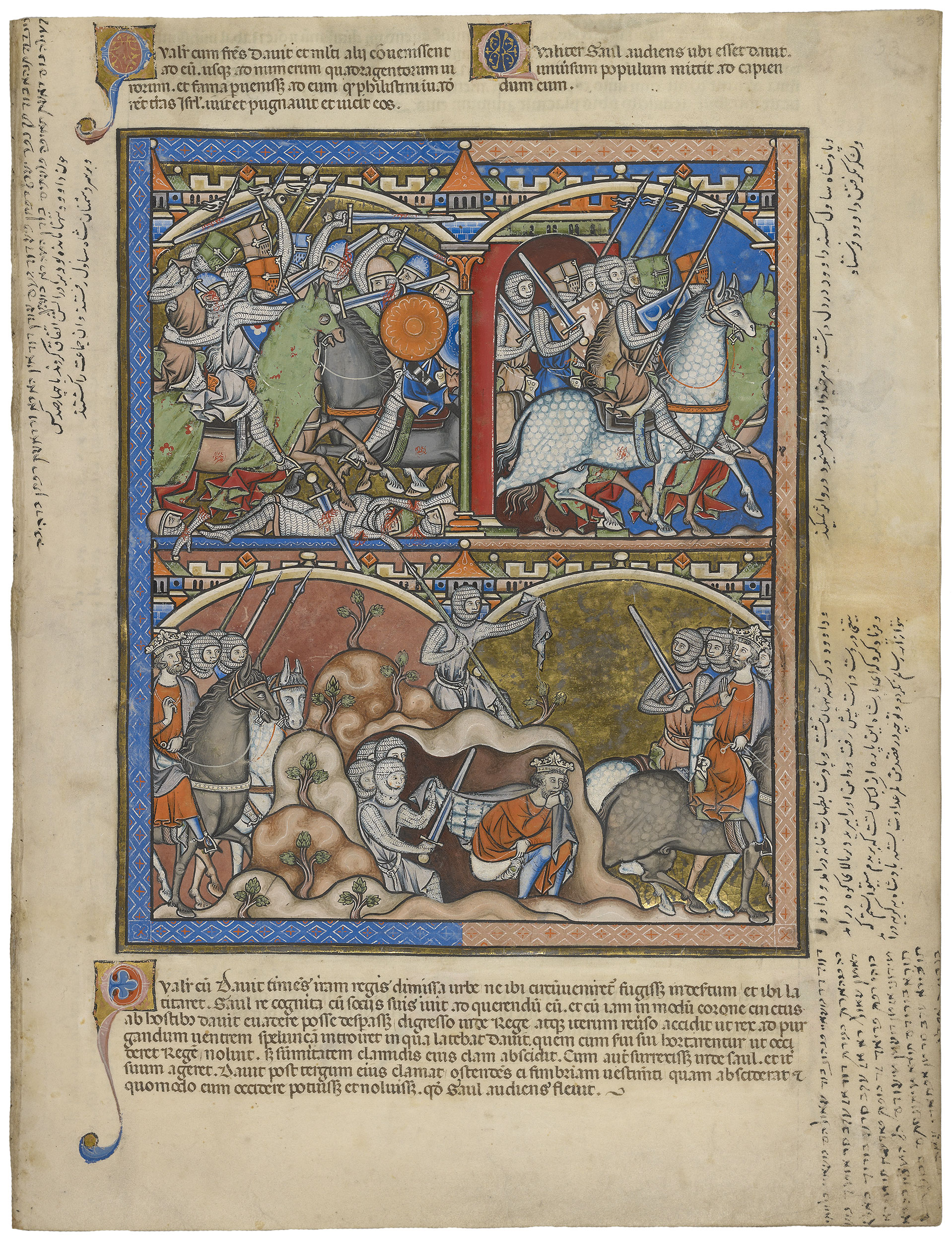
Keilah Liberated, Retreat, Royal Repose
Old Testament Miniatures with Latin, Persian, and Judeo-Persian inscriptions
Purchased by J.P. Morgan (1867–1943) in 1916
Folio 33r (Latin)
Upper left: When David’s brothers and many others, up to the number of four hundred, came together to him, and when he heard that the Philistines had invaded the land of Israel, he went, fought with them, and defeated them. (I Samuel 23 1–5)
Upper right: How Saul, upon hearing where David was, sent all the people to catch him. (I Samuel 23: 19–26)
Lower half: How, when David, fearing the king’s anger, had left the city that he might not be surrounded there, and had fled to the desert where he was hiding, Saul, who had discovered it, went out with his allies to seek him. When he was surrounded all around and had given up hope of escaping, the king having departed and returned again, it came to pass that the king entered the cave where David was to purge his stomach. David refused to kill him, although his servants encouraged him to do so, and secretly cut off the tip of his mantle. When Saul had stood up and was on his way, David cried behind his back, showing him the tip of his cloth, which he had cut off, saying that he could have killed him but had refused. Upon hearing this, Saul wept. (I Samuel 24: 1–16)
Folio 33r (Persian)
Upper left margin: Since David had remained alone, his brothers conspired with four hundred men and they descended upon the enemies of King Saul and slew them.
Upper right margin: King Saul held a grudge against David and however much ingenuity David showed it did not affect [the king]. He [again] sent out an army to capture David.
Lower right margin: David sat hiding in a corner and the king came to the privy. David had a knife in hand; he went forth and cut off his skirt. And he climbed to the top of the mountain and cried, "O, king, this piece is from your mantle that I have cut; I could have harmed you; I did not; why do you wage war towards me?" The king burst into weeping.
Folio 33r (Judeo-Persian)
Upper left margin, furthest left: When David was alone four hundred and twenty Israelites went before David. Having gathered together, David took them and went to a village called Keilah where there was a tribe of Philistines, and they killed all of them.
Lower right margin, corner: David was hidden in a corner while Saul was also in a private corner to purify himself. David approached from the back...and cut off a piece of Saul’s mantle from behind. [Then David] went on top of a hill and shouted, saying, "King, you know me, and you think that I’ve become [your] enemy, [now see this piece of your mantle] which I cut off. I could have killed you..., so why are you after me?"....
Keilah Liberated
David, in obedience to the Lord's command, engages the Philistines at Keilah in furious combat. The Israelites grapple with their opponents and strike terrible blows. (1 Kings 23:4–5)
Retreat
Saul will soon arrive in Keilah. The Lord warns David that the people of the town will betray him to the king, so he gathers his forces and departs. (1 Kings 23:10–13)
Royal Repose
Later, Saul and his army arrive at the cave of En Gedi, where David and his men lie hidden. As the king empties his bowels in the dark cave, David quietly shears a corner from his mantle. When Saul and his troops leave the cave, they are startled by David, who protests his allegiance to the king. He holds aloft his trophy as proof that, had he desired, he could have easily slain Saul. (1 Kings 24:3–12)