
Jonathan Brokers Peace, The War Resumes, Saul's Rage, A Second Assassination Attempt
Old Testament Miniatures with Latin, Persian, and Judeo-Persian inscriptions
Purchased by J.P. Morgan (1867–1943) in 1916
Folio 30v (Latin)
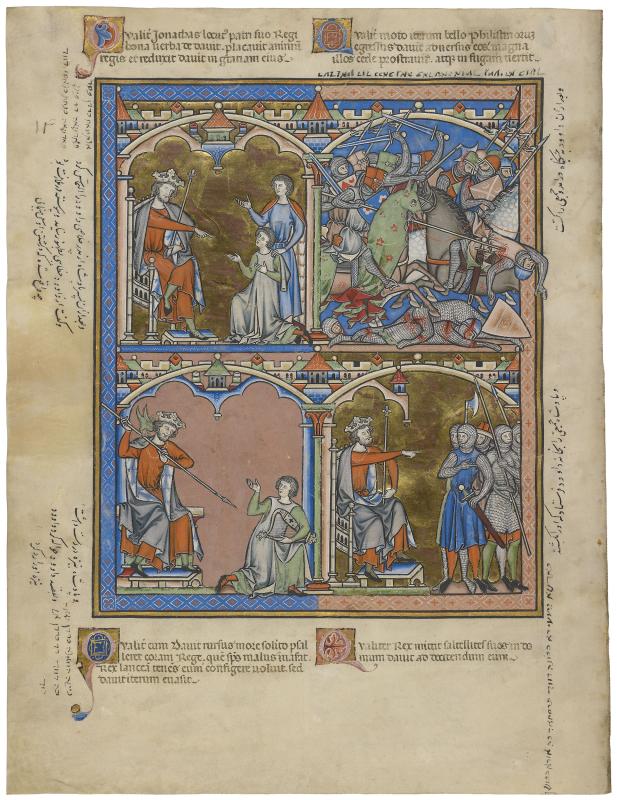
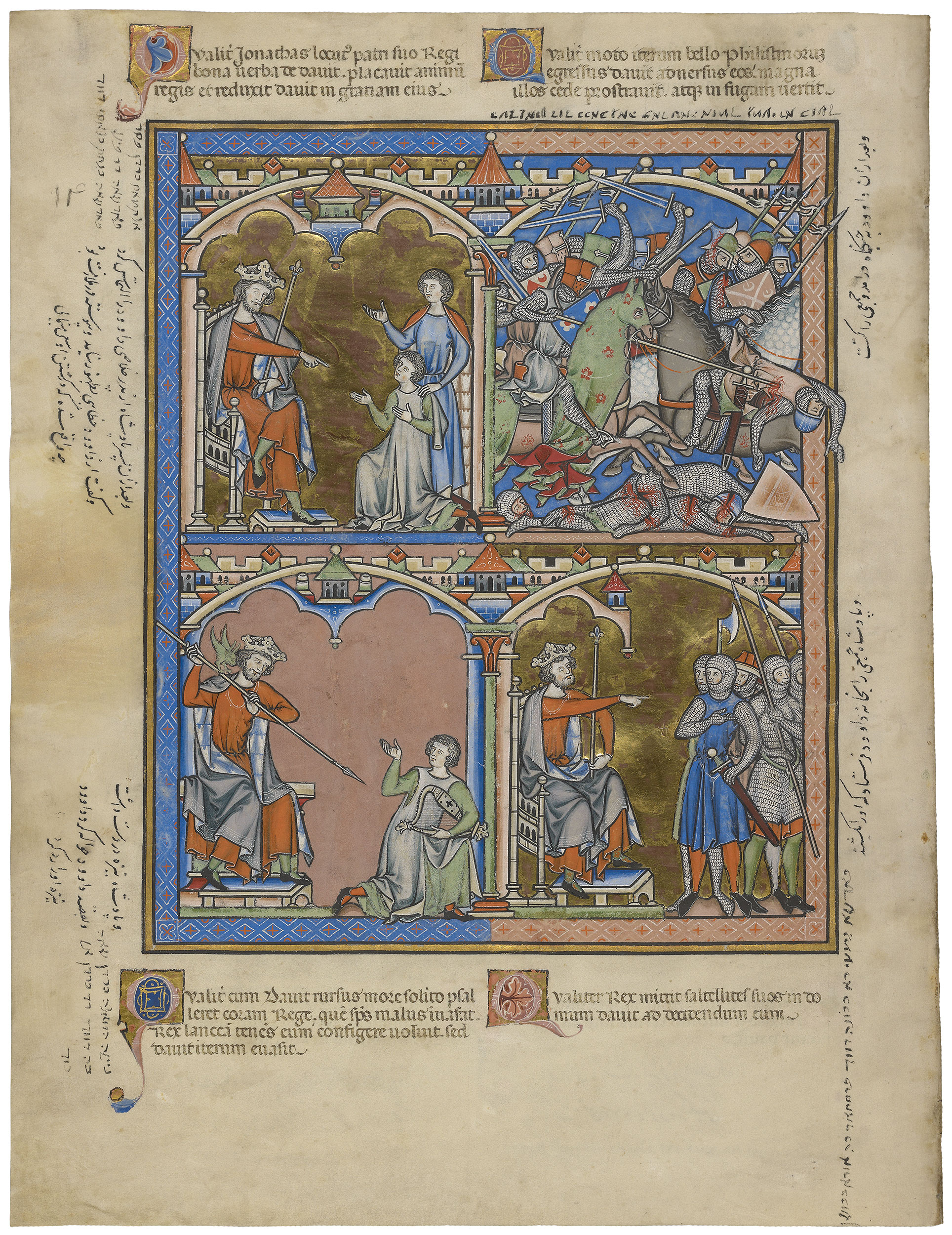
Upper left: How Jonathan, having spoke good of David to his father, the king, soothed his mind and makes David agreeable to him. (I Samuel 19: 4–7)
Upper right: How, when the war with the Philistines had begun again, David went out and fought against them and defeated them with a great slaughter and they fled. (I Samuel 19: 8)
Lower left: How, when the evil spirit has come again upon the king, as David was playing before him, as he was accustomed, the king, holding his spear, wished to pierce him but David went out again. (I Samuel. 19:9, 10)
Lower right: How Saul sends his guards to kill David in his house. (I Samuel 19:11)
Folio 30v (Persian)
Persian foliation: 14
Upper left margin: And after that, the king’s son blessed his father for David’s release and said, "No evil has come from David and he has always been at [your] service; what has happened that you attempt to kill him?"
Upper right margin: Afterwards David came to the battlefield and slew a group.
Lower left margin: The king had a spear in hand and he threw it at David; David repelled his spear.
Lower right margin: The king sent a company to David’s house to kill him.
Folio 30v (Judeo-Persian)
Upper left margin, corner: The king’s son supplicates his father for David’s deliverance.
Upper right, below Latin: Afterwards David came to the king’s sleeping quarters and killed a group [of the enemy].
Lower left margin, corner: The king threw the spear at David but he repelled it.
Lower right margin, corner: The king sends a group [of men] to David’s house in order to kill him.
Jonathan Brokers Peace
Jonathan, having warned David, protests his friend's innocence to the king. As proof of David's loyalty, the prince recounts the many feats of arms his friend has undertaken in Saul's name. Saul is dissuaded from killing David and once again receives him at court. (1 Kings 19:3–7)
The War Resumes
Again, the Israelites engage the Philistines. David and his company slaughter a great number of the enemy and chase them from the battlefield. (1 Kings 19:8)
Saul's Rage
Saul is again afflicted by an evil spirit sent by the Lord. The jealous king takes aim at his son-in-law with a spear, but David neatly steps aside and out of harm's way. (1 Kings 19: 9–10)
A Second Assassination Attempt
Saul directs his soldiers to surround David's home and to kill him in the morning. (1 Kings 19:11)