

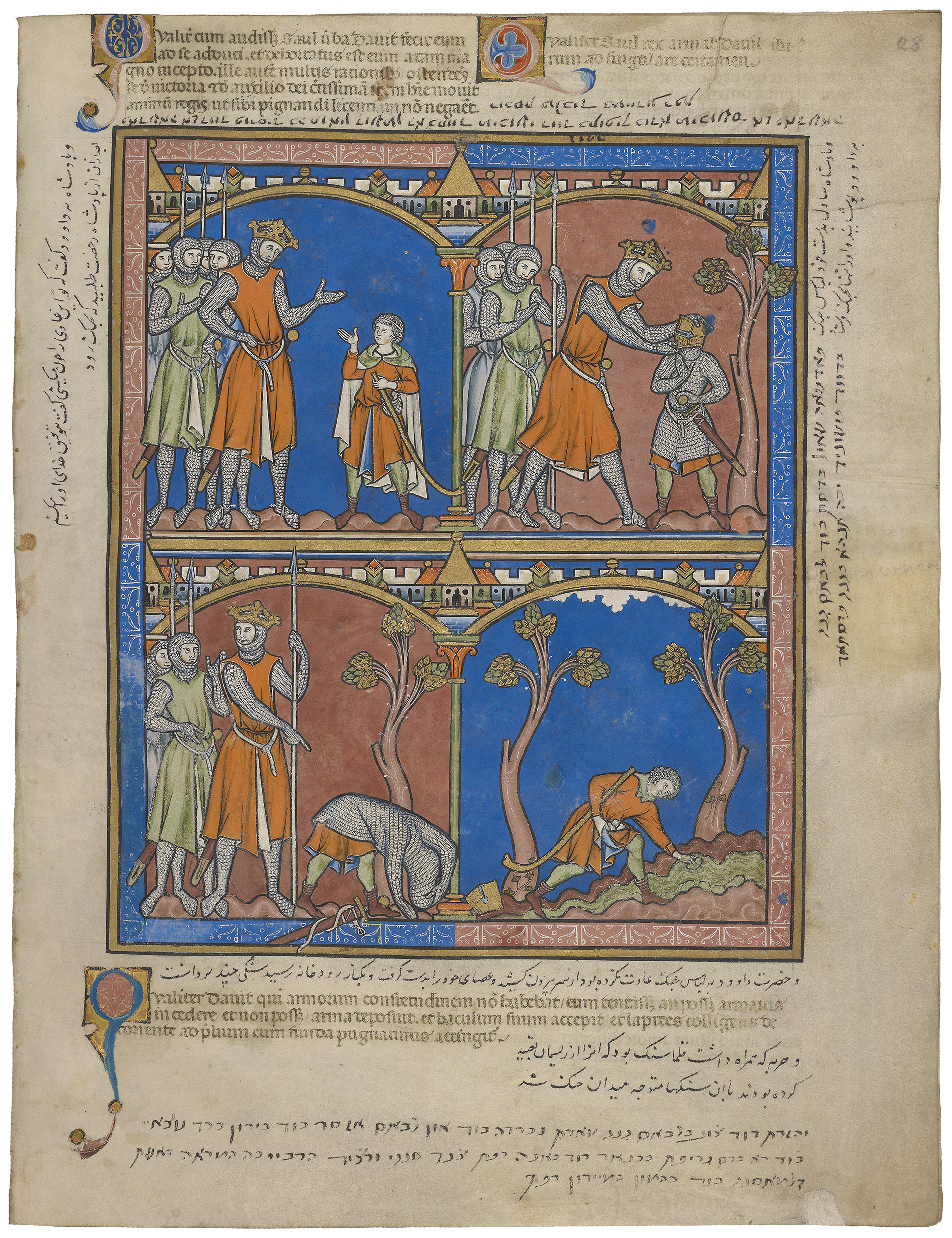
David Petitions Saul, David Armed for the Combat, David Removes the Armor
Old Testament Miniatures with Latin, Persian, and Judeo-Persian inscriptions
Purchased by J.P. Morgan (1867–1943) in 1916
Folio 28r (Latin)
Upper left: How, when Saul had heard David’s words, he had him brought to him and discouraged him from entering upon such a great undertaking. But he, showing in many ways that he had the highest hope regarding both himself and God’s help, influenced the king’s mind not to deny him his battle plan. (I Samuel 17:31–37)
Upper right: How Saul arms David who is about to go to the hand-to-hand fight. (I Samuel 17: 38)
Lower half: How David, who was not accustomed to arms, having attempted to walk in armor and could not, laid off his arms, took his staff, and, collecting stones from a stream, arms himself for battle, as he is about to fight with his sling. (I Samuel 17: 39–40)
Folio 28r (Persian)
Upper left margin: And the king asked David, "How will you kill this giant?" He said, "By the grace of God, I will kill him." Then he requested permission from the king to go to battle.
Upper right margin: King Saul, with his own hands, clothed him in armor and sent him alone into battle.
Lower half, above and below Latin inscriptions: His Excellence David was not accustomed to armor; he removed it off his head and took his staff and came to the river bank. He picked up a few stones and turned towards the battlefield with the weapon which he had along [and], which was a sling hung on a rope and those stones.
Folio 28r (Judeo-Persian)
Upper half, beneath Latin: The king asked David, "How will you kill this enemy?" David [replied], "I will kill him with the grace of God." Having sought the king’s permission, he went into the battlefield.
Right margin, middle: King Saul with his own hand[s] dressed David with garments of war and sent him into the battle all by himself.
Lower half, beneath Persian: His Excellence David, since he was unaccustomed to garments of war, removed those garments off his head, took hold of his own staff, went by the river bank, collected a few stones, the weapon which he had, and the sling and stones and with these he went onto the battlefield.
David Petitions Saul
David, his shepherd's crook in hand, asks King Saul for the right to do battle with Goliath. The king attempts to dissuade his youthful servant from this dangerous task, but David is adamant. With the Lord's help, David explains, he has slain a lion and a bear. So will the Philistine giant fall, for he has dared to curse the army of the Living God. The king yields. Saul's warriors glance at each other, clearly uncertain of the wisdom of this decision. (1 Kings 17:31–37)
David Armed for the Combat
Saul, resigned to David's wishes, clothes David with a coat of mail and fits a great helm over his head. (1 Kings 17:38)
David Removes the Armor
Unaccustomed to the weight and bulk of the armor, David removes his helmet and sword and pulls the mail coat off over his head. Taking hold of his shepherd's staff, he makes his way to a brook and pulls five smooth stones from the water. (1 Kings 17:39–40)