

Just Desserts, Divine Favor, A Thanksgiving, Samson, Mightiest of Men
Old Testament Miniatures with Latin, Persian, and Judeo-Persian inscriptions
Purchased by J.P. Morgan (1867–1943) in 1916
Folio 14r (Latin)
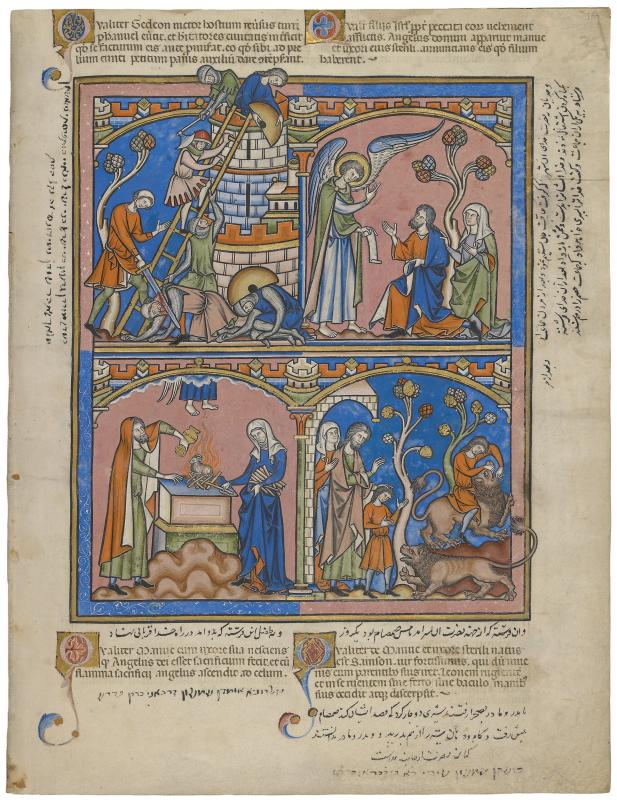
Upper left: How Gideon returned as a victor, tore down the tower of Penuel and killed the city’s inhabitants, because he had told them before that he would do it, and because they had refused to give him bread as he was going to battle. (Judges 8: 5–17)
Upper right: How, as the children of Israel were vehemently afflicted on account of their sins, an angel of the Lord appeared to Manoah and his barren wife announcing the birth of a son. (Judges 13: 1–14)
Lower left: How Manoah and his wife, unaware of the fact that he was an angel of the Lord, offered a sacrifice, and the angel ascended to heaven with the victim’s dame. (Judges 13: 15–23)
Lower right: How Samson, a man of enormous strength, was born to Manoah and his sterile wife. When as a youth he was traveling with his parents and a lion rushed toward him roaring, he killed and dismembered it with his hand with no sword or staff. (Judges 13: 24 – 14:6)
Folio 14r (Persian)
Upper right margin: And when Gideon, with God’s assistance, had taken that city, he finally breathed his last breath and after his death his people fell into sin and God delivered them back into the hands of the enemy. Thereafter, God send an angel to one of those people and he said, "God will grant you a son who will vanquish the enemy."
(Fragment beneath # 93) And after...
Lower left: And because of this child, whom the angel foretold, he offered sacrifices to God.
Lower right, above and below Latin inscription: And the angel who came to help a son to be born; his name was Samsam (Samson). One day, he went with his mother and father to the fields. He encountered a lion who charged towards them. Samson stepped forth and tore apart the lion’s jaw and mouth and the father and mother did not know that this help issued from God.
Folio 14r (Judeo-Persian)
Upper left margin: After the death of Gideon, the Children of Israel are at the place of their idolatry. I don’t know what tale this is.
Lower left, beneath Latin: The tale of the birth of Samson; the sacrificial offering of his father.
Lower right, beneath Persian: Samson’s killing of a lion without anyone’s knowledge.
Italicized words are in Hebrew.
Just Desserts
Abimelech has ruled Israel for three years, but the Lord does not favor this usurper. From atop the besieged stronghold of Thebez, a woman takes aim at Abimelech with a piece of a millstone. The stone dashes against his head, crushing his skull. With his remaining strength, Abimelech summons his armor bearer, begging that he be slain by a sword so that men will not say that he was killed by a woman. Abimelech appears twice—once beneath the millstone and once beneath the sword—but in different clothing. The reason for this inconsistency in a single miniature is unclear. (Judges 9:50–54)
Divine Favor
The Israelites are sinful in the eyes of the Lord and must serve the Philistines for forty years. But again, the Lord prepares a deliverer. An angel of the Lord visits Manoah, of the tribe of Dan, and his barren wife (In the biblical account, Manoah is not present). The angel promises that Manoah's wife will conceive and bear a son. She is to partake neither of wine nor of strong drink during the pregnancy, for the boy is to be a Nazirite, that is, a consecrated one. Most importantly, a razor is never to touch one hair of the boy's head. (Judges 13:2–5)
A Thanksgiving
Manoah invites the Lord's angel to dine, but the angel would rather Manoah make a burnt offering to the Lord. Accordingly Manoah chooses a kid from the flocks and prepares it on an altar. As Manoah pours an offering of oil and his wife feeds the fire, the angel ascends to heaven in the midst of the rising flames. (Judges 13:15–20)
Samson, Mightiest of Men
As the Lord promised, Manoah's wife conceives a boy, Samson. When he comes of age, his parents accompany him to Timnah to choose a wife. On the way, the family is surprised by a vicious, raging lion. The spirit of the Lord comes upon the young Samson. Samson steals away from his parents and, without their knowledge, rips the lion to pieces with his hands alone. (Judges 14:5–6)