

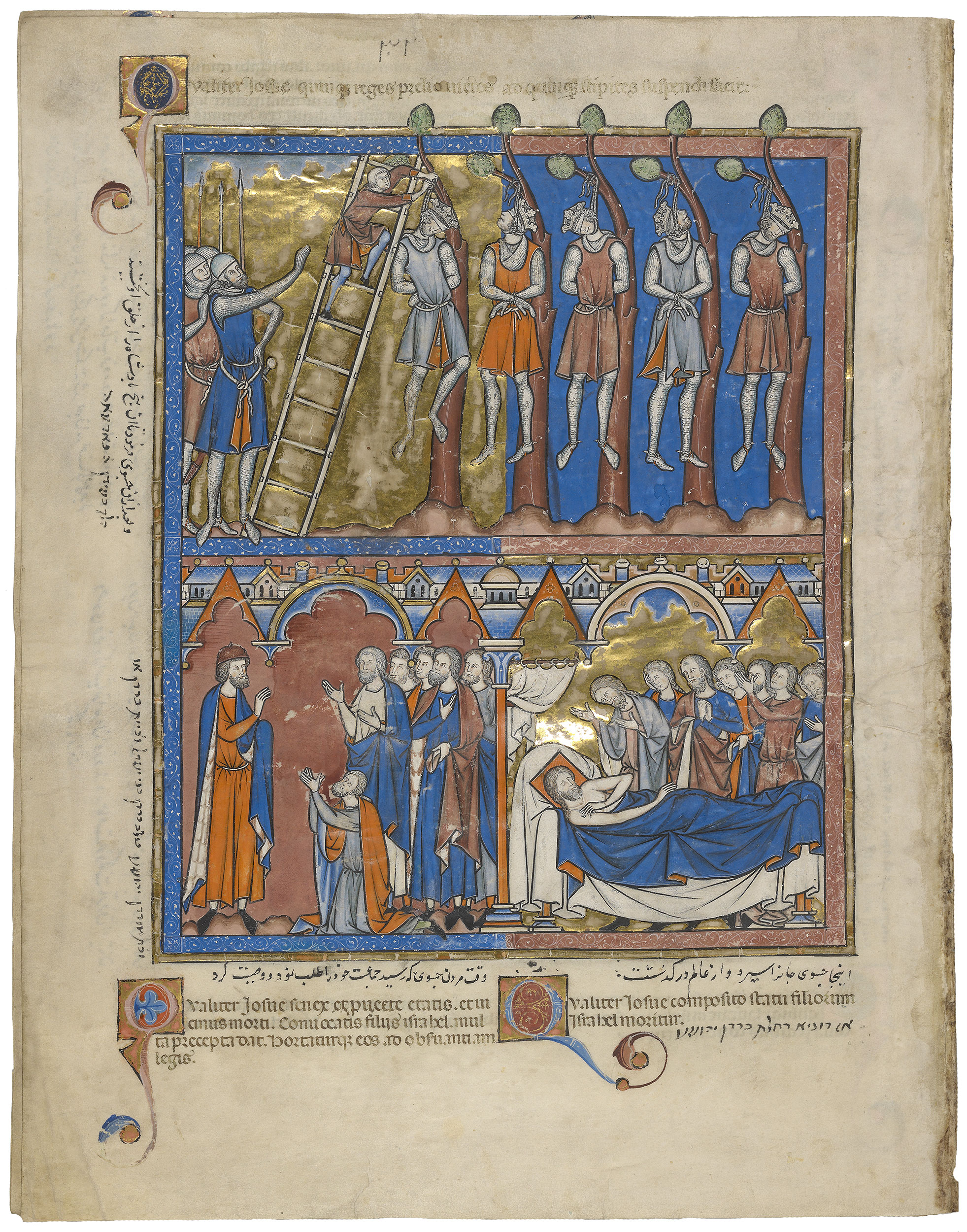
An Execution, Joshua's Final Commands, Joshua's Passing
Old Testament Miniatures with Latin, Persian, and Judeo-Persian inscriptions
Purchased by J.P. Morgan (1867–1943) in 1916
Folio 11v (Latin)
Upper half: How Joshua had the five kings who had been defeated in battle hanged on trees. (Joshua 10: 26)
Lower left: How Joshua, old, advanced in years and near death, gives many orders to the assembled children of Israel, encouraging them to be observant of the laws. (Joshua 23: 1–24 – 24)
Lower right: How, the affairs of the children of Israel now settled, Joshua dies. (Joshua 24: 29)
Folio 11v (Persian)
Persian foliation: 33
Upper left margin: And after that Joshua ordered those five kings to be hanged.
Lower left: When Joshua’s death neared, he summoned his people and gave his last testament.
Lower right: Here, Joshua breathed his last breath and died.
Folio 11v (Judeo-Persian)
Upper left margin, furthest left: The hanging of the five kings.
Lower left margin: At the time of Joshua’s death, he seeks out the Children of Israel and bequeaths his will.
Lower right, beneath Latin: Joshua’s departure from the world.
Italicized words are in Hebrew.
An Execution
After their humiliation, the five Amorite kings are hanged for a full day. Come evening, Joshua orders a soldier to take the bodies down. (Joshua 10:26–27)
Joshua's Final Commands
Years later, before his own death, an elderly Joshua exhorts the leaders of Israel to remember the many blessings of the Lord and to obey the law of Moses. (Joshua 23:1–14)
Joshua's Passing
Beside Joshua's deathbed, the people grieve and mourn the passing of their great leader. (Joshua 24:29–31)