

A Bride Price, A Covenant, Wrestling the Almighty, All is Forgiven
Old Testament Miniatures with Latin, Persian, and Judeo-Persian inscriptions
Purchased by J.P. Morgan (1867–1943) in 1916
Folio 4v (Latin)
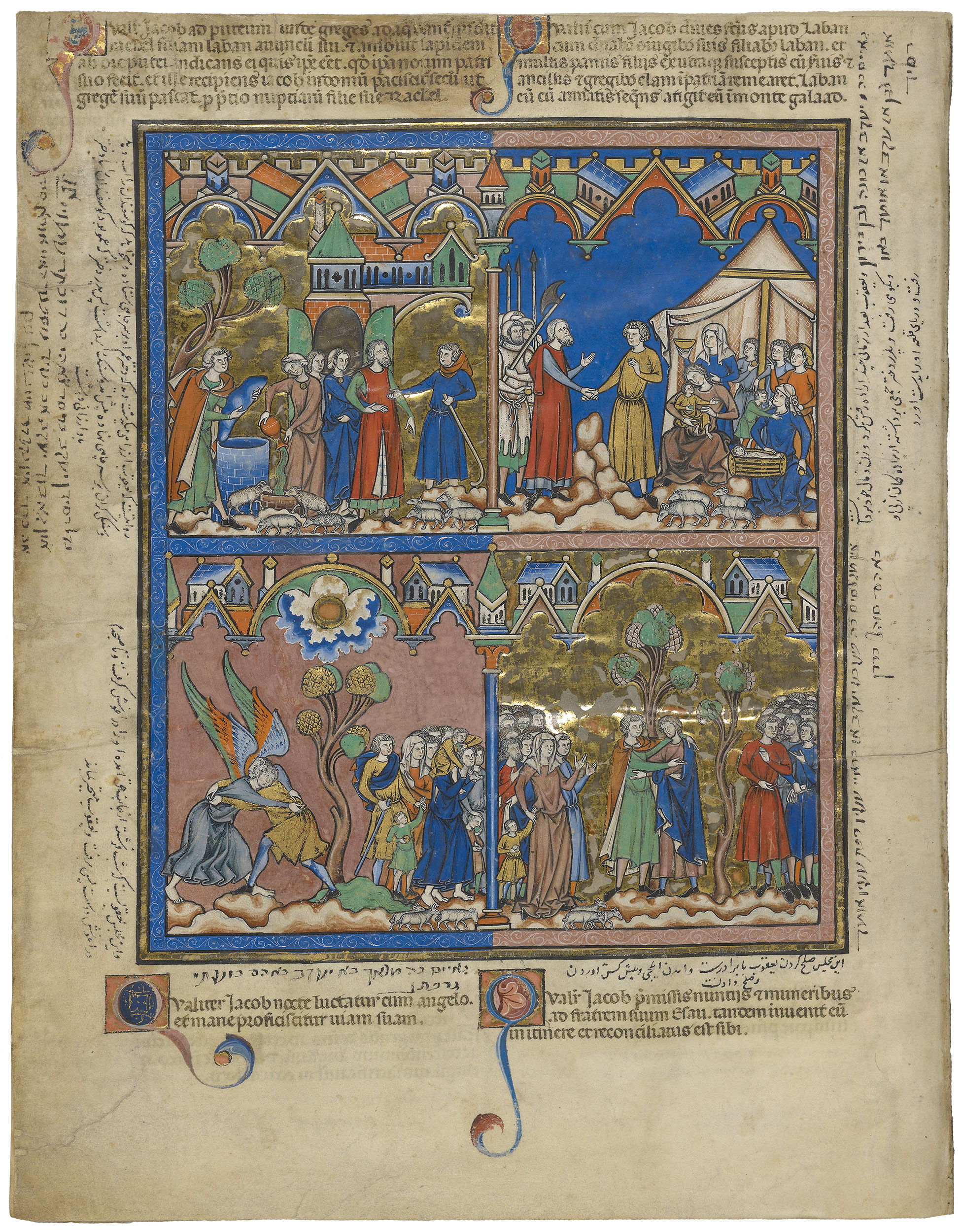
Upper left: How Jacob saw Rachel the daughter of Laban, his uncle near a well whence the flocks were watered and rolled the stone from the mouth of the well telling her who he was which she told her father and he, receiving Jacob in his house, makes a pact with him to tend his flocks in return for the hand of his daughter, Rachel. (Genesis 29: 1–20)
Upper right: How when Jacob who was made rich at Laban’s side was secretly returning to his homeland with his two wives, Laban’s daughters, with many young children born of each and with slaves and maids and ilochs, Laban pursued him with armed men and overtook him in mount Gilead. (Genesis 31)
Lower left: How Jacob wrestled with the angel and on the breaking of the day set out on his way. (Genesis 32: 24–31)
Lower right: How Jacob having sent messengers and presents to Esau, his brother, found him at last on his way and reconciled with him. (Genesis 32: 3–23, 32:1–15)
Folio 4v (Persian)
Upper left margin: According to legend, Jacob was walking a road; he saw his cousin standing by a well and, wanting to water the sheep and [seeing] a heavy stone on top of the well, he came forth and removed the stone. Accordingly, the girl’s father, who was his uncle, granted him his sheep and his daughter.
Upper right margin: After some time, Jacob decided to leave and took his wife and possessions and went to a mountain. The girl’s father gathered a group and pursued him on foot and caught up with him at the foot of the castle.
Lower left margin: And this is the image of Jacob when, at night, an angel of God came and embraced him and kept him till dawn in his embrace. Then he left and Jacob was struck with awe.
Lower right: This is the image of Jacob making peace with his brother [Esau], the arrival of [Jacob’s] ambassador, and the presentation of offerings, and the making of peace [with Esau].
Folio 4v (Judeo-Persian)
Upper left margin, furthest left: The tale of Jacob’s arrival at the mouth of the well where the daughter of his uncle was; Jacob drew water, quenched the thirst of her flock;....
Upper right margin, top: Here it is that Jacob, upon leaving Laban’s house, Laban comes after him and catches up with him.
Lower left, above Latin: Here it is that the angel and Jacob wrestle one another.
Lower right margin: This is the scene when, Jacob’s gifts having come before Esau, Esau comes and they are reconciled.
A Bride Price
Jacob travels in search of his uncle, Laban. At Laban's well, Jacob meets his cousin Rachel, a shepherdess. Jacob removes the stone cover of the well, enabling Rachel to water her flock. Later, as Rachel and her elder sister Leah look on, Jacob petitions Laban for Rachel's hand in marriage. In return, Jacob swears to serve his uncle for seven years. (Genesis 29:10–20)
A Covenant
Laban, accompanied by his brothers, agrees to give both of his daughters to Jacob in marriage. Laban clasps his nephew's hands over a heap of stones that will serve both as witness to their covenant and boundary marker between their lands. Leah and Rachel observe them from a nearby tent. They are surrounded by their children and handmaidens. Rachel rocks Joseph, Jacob's youngest son, in his cradle. (Genesis 31:43–48)
Wrestling the Almighty
In the night, Jacob orders his family to cross the ford of Jabbok. When all have crossed but Jacob, an angel of the Lord appears and wrestles with him until sunrise. Jacob will not surrender and demands a blessing from his heaven-sent opponent. "Your name shall no longer be called Jacob, but Israel" the angel proclaims, "for you have struggled with God and with men, and have prevailed." (Genesis 32:22–31)
All is Forgiven
After many years, Jacob and Esau are reconciled to one another. At left, the family and servants of Jacob watch the reunion. At right, Esau's men regard the brothers' embrace. (Genesis 33:1–7)