
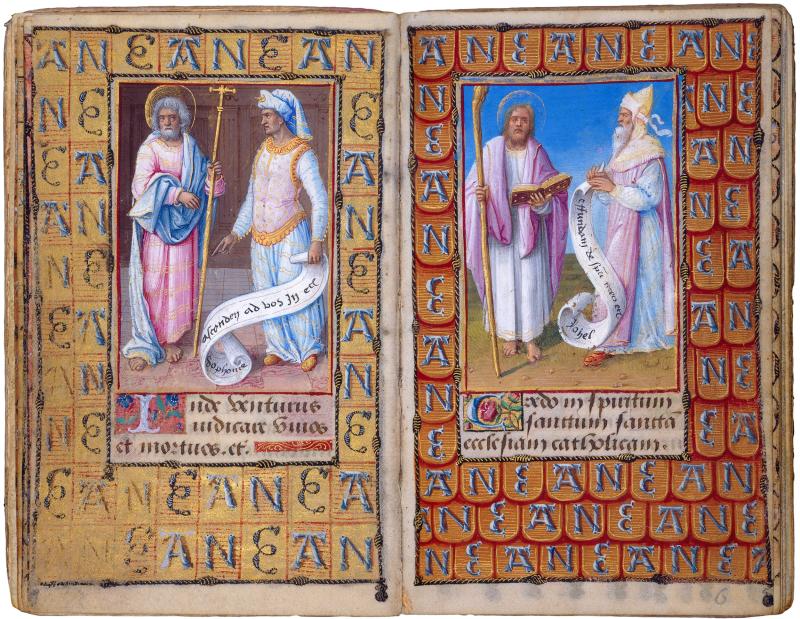

The Apostle Simon and the Prophet Sophonias
The Apostle James the Minor and the Prophet Joel
Prayer Book of Anne de Bretagne
Illuminated by Jean Poyer
The Pierpont Morgan Library, Purchased in 1905
The Apostle Simon and the Prophet Sophonias (fol. 5v, left)
Poyer skillfully depicts Simon and Sophonias in a subtly dramatic moment, in which the prophet sternly gestures to the cautious Apostle.
Sophonias's scroll is appropriate for his serious demeanor and gesture of warning. Inscribed "I will come to you in judgement," the words prophesize Christ's judgment of humankind on the Last Day, also the theme of the accompanying Article of Faith. The scroll attributes the text to Sophonias, when it was actually written by the prophet Malachi; this is one of many such mistakes of textual attribution.
The Apostle James the Minor and the Prophet Joel (fol. 6, right)
James, the first bishop of Jerusalem, stands with the club with which he was beaten to death, and a book of the New Testament in a barren landscape with the prophet Joel.
James was clubbed to death with a fuller's bat (a club used to full, or cleanse, cloth by beating) after he was thrown from the parapet of the Temple in Jerusalem. He was perceived as a threat becausehe had converted so many Jews to Christianity.
The bound book that James (like Peter, Bartholomew, and Matthias) holds contrasts with Joel's scroll. In medieval and Renaissance art, roll and codex often represent the Jewish Old Testament and the Christian New Law.