
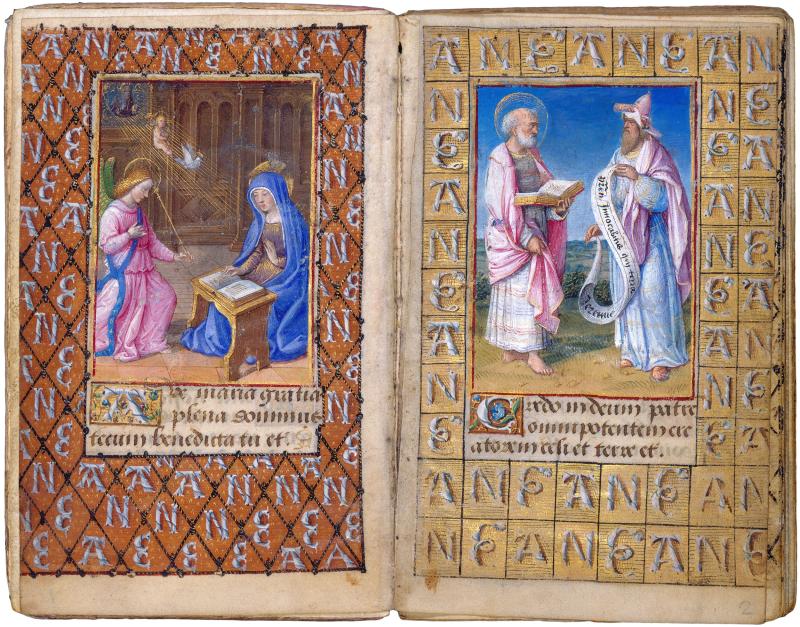
Annunciation
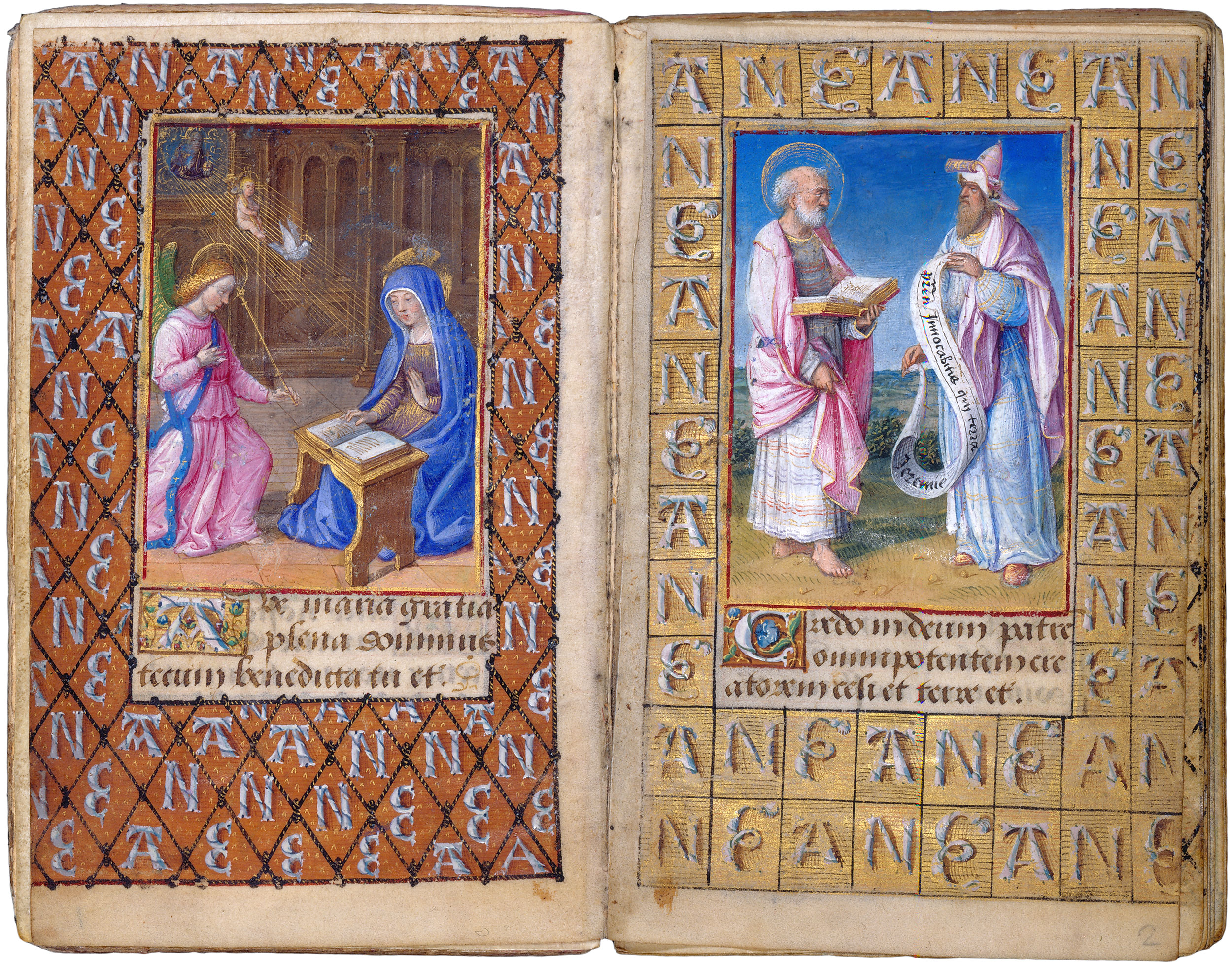
The Apostle Peter and the Prophet Jeremiah
Prayer Book of Anne de Bretagne
Illuminated by Jean Poyer
The Pierpont Morgan Library, Purchased in 1905
Annunciation (fol. 1v, left)
The Virgin Mary, surprised at her prayers, raises her eyes at Gabriel's announcement that she has been chosen to be the Mother of God. The miniature accompanies the Hail Mary.
The Virgin, who is depicted praying, serves as a pious visual model for Anne de Bretagne who, herself a mother, commissioned the Prayer Book.
Poyer depicts God the Father, holding an orb, sending forth the Christ Child, who bearing a Cross, follows the Holy Spirit in the form of a dove, along golden rays toward his future mother. Beginning in the fourteenth century, artists employed this iconography to indicate the involvement of all Three Persons of the Trinity in the miracle of the Incarnation.
Et is a Latin abbreviation for etcetera, meaning "and the rest." The text of the Hail Mary is actually incomplete: there was insufficient space on the page to write the whole prayer, and, in any case, Anne de Bretagne knew the words by heart.
The Apostle Peter and the Prophet Jeremiah (fol. 2, right)
Peter and Jeremiah begin a series of twelve illuminations pairing an Apostle, identified with a halo and an attribute, with a prophet of the Old Testament holding a scroll.
Poyer followed artistic and theological tradition by depicting Peter, the "Prince of the Apostles" and the "rock" (from the Greek word Petros) upon which Christ built the Church, first among his series of Apostles.
The Apostles' Creed, the prayer that accompanies the following series oftwelve miniatures, along with the Our Father and Hail Mary that begin the book, were rarely found in medieval and Renaissance prayer books because every Christian knew them by heart. Their presence here indicates that this book was made for a child.